Table of Contents
- Key Takeaways
- Medically Reviewed By
- The Role of Exosomes in Regenerative Medicine
- What Are Exosomes?
- Why Are Exosomes Important in Regenerative Medicine Research?
- How Do Exosomes Support Cellular Communication?
- What Is the Relationship Between Stem Cells and Exosomes?
- How Are Exosomes Being Studied Across Different Healthcare Fields?
- What Does Current Research Suggest About Exosomes?
- What Challenges Remain in Exosome Research?
- Looking Ahead in Exosome Research
- Frequently Asked Questions
- Reference Links
- Medical Disclaimer
Exosomes are small extracellular vesicles produced by cells that help transport biological information between different cells and tissues. scientist are exploring their role in regenerative medicine—as they may contribute to cellular communication, tissue responses, and biological signalling. While the interest in exosomes continues to grow, several applications remain under investigation and need further research.
Key Takeaways
- Exosomes are small extracellular vesicles that play an important role in cellular communication.
- Researchers are studying exosomes to better understand biological signaling and tissue responses.
- Exosomes are frequently investigated alongside stem cells and regenerative medicine research.
- These vesicles can carry proteins, RNA, lipids, and other signaling molecules between cells.
- Current research is exploring the role of exosomes across multiple healthcare and scientific fields.
- Many exosome-based applications remain investigational and require further clinical research.
Medically Reviewed By
Written By – Nishat Arfin
Scientific Review By – Tabish Iqbal
Medically Approved By – Global Stem Cell Care Medical Team
Last Reviewed: June 2026
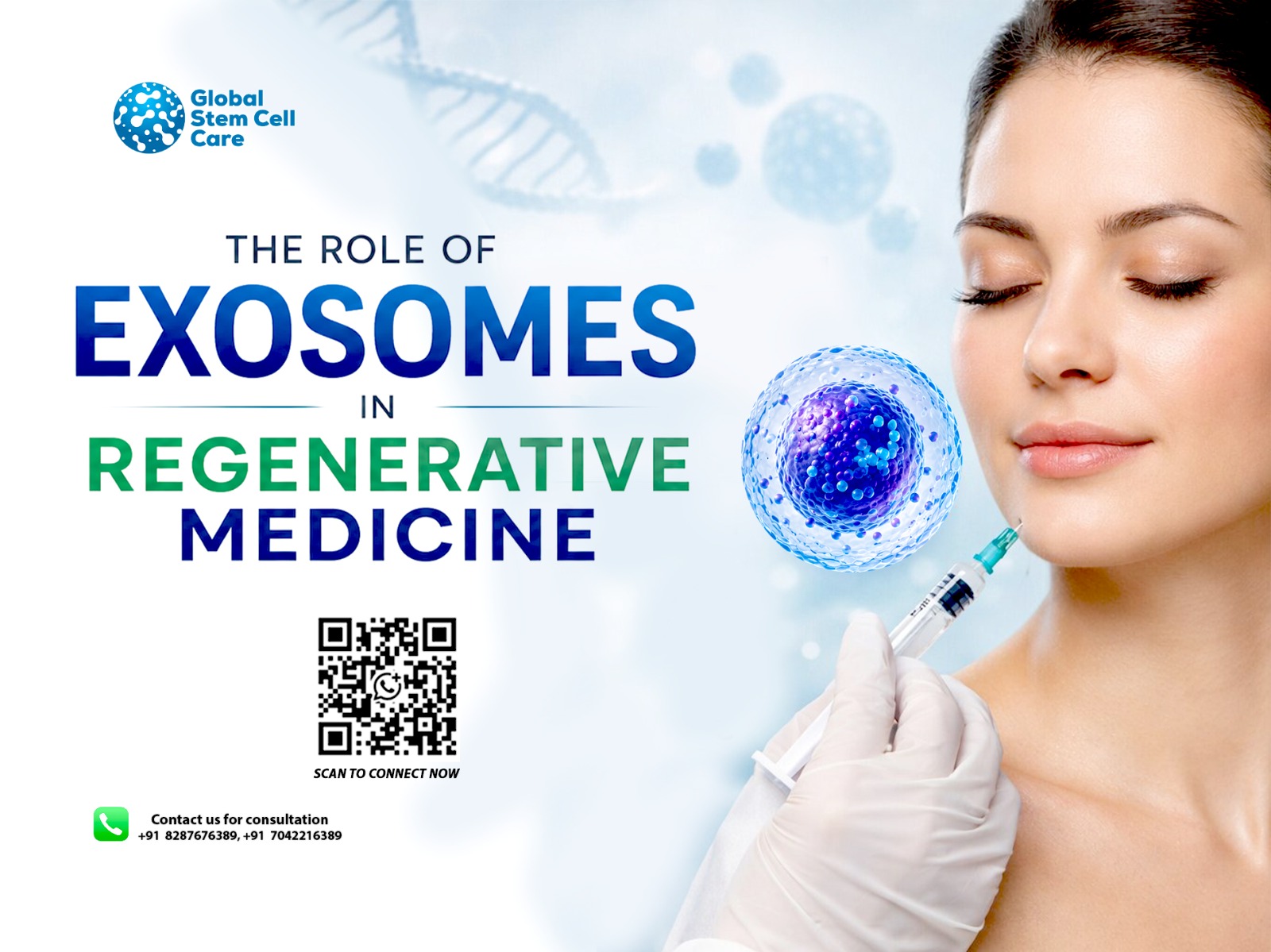
The Role of Exosomes in Regenerative Medicine
Regenerative medicine is a rapidly growing part of healthcare research, focusing on understanding how tissue repair, cellular communication, and biological processes help in recovery. As scientific knowledge continues to expand in recent years, researchers are exploring various components that may contribute to these complex biological activities.
The exosomes are among these factors. These are tiny vesicles that occur naturally in the body through secretion by the cells. Researchers are investigating exosomes due to their role in cellular communication.
In this blog post, you will learn about exosomes, their research in regenerative medicine, and their relevance as an area of scientific investigation.
What Are Exosomes?
Exosomes are small extracellular vesicles naturally released by many types of cells in the body. However, because they are microscopic, researchers have become interested in them for their role in transferring biological information between cells.
These small vesicles often contain a variety of biological materials, such as proteins, lipids, messenger RNA (mRNA), microRNA (miRNA), and some other signalling molecules. Once produced, exosomes can interact with nearby or distant cells, allowing researchers to explore how cell communication coordinates biological activities.
Scientists regard exosomes as an important part of cellular communication—as they may influence how cells respond to their surrounding environment. This is what has increased their relevance in scientific studies to understand both biological processes and healthcare research.
The features of exosomes that are important for scientists are as follows:
- Biological Messengers: The exosomes are capable of transporting biological information between cells that will assist scientists in studying the process of cellular communication.
- Molecular Cargo: They carry biological molecules such as proteins, RNAs, and other lipid molecules inside the body.
- Researching Potential: Scientists have discovered that exosomes can potentially help to understand more about tissue biology, cellular communication, and regenerative medicine.
With the advancement of scientific knowledge, exosomes are now being studied extensively in relation to stem cells, tissue research, and regenerative medicine.
Why Are Exosomes Important in Regenerative Medicine Research?
Exosomes have become an important area of investigation in regenerative medicine research. Scientists explore exosomes as they may help better understand how cells communicate, respond to biological signals, and interact with surrounding tissues. As this field continues to explore complex biological processes, exosomes provide another way to study how information is exchanged between cells.
Unlike some traditional approaches focuses primarily on individual cells, exosome research allows scientists to investigate how molecular messenger cells respond during various biological activities. Exosome studies have opened up new avenues of research into the role of exosomes in the cellular communication network.
Several factors contribute to the growing interest in exosome research. Scientists are investigating exosomes because they may help improve understanding of cellular communication, tissue interactions, biological signaling, and the movement of molecular information between cells. Their presence across different biological systems has also encouraged researchers to explore their role in regenerative medicine and related scientific fields.
As research continues, exosomes remain an important area of investigation for understanding complex biological processes and cellular behavior.
How Do Exosomes Support Cellular Communication?
The area of cellular communication is most actively studied in exosomes research. Researchers are currently investigating how exosomes may help transfer biological information between cells and respond to communication across different tissues and biological environments.
Some of the current areas of interest are:
- Signaling Molecules: Exosomes may transport proteins, lipids, and RNA molecules, which might affect the way in which cellular signaling occurs.
- Cellular Communication: Exosome involvement in cellular signaling and coordination is one of the areas being investigated by researchers.
- Interaction with Tissues: Exosomes may interact with the tissues surrounding them and be involved in complex biological processes.
Exosomes continue to be important in research related to cellular signaling, stem cell investigations, and regenerative medicine.
What Is the Relationship Between Stem Cells and Exosomes?
Scientists often study exosomes and stem cells together, as they both play an important role in regenerative medicine research. For decades, scientists have become interested in understanding how exosomes released by stem cells may support cellular communication and biological signalling.
Among the various types of stem cells, mesenchymal stem cells (MSCs) have been extensively studied with respect to exosomes. It is currently being researched how exosomes derived from stem cells might function within the body.
Other research focuses include the following:
- Stem Cell Signaling: Scientists are researching whether exosomes could be involved in transporting the signaling molecules released by stem cells.
- Cellular Communication: Researchers are examining whether exosomes from stem cells play a role in cellular communications.
- Tissue Interactions: The interaction of exosomes with the surrounding biological environment of tissues is under continued investigation.
- Regenerative Medicine Research: Exosomes are commonly studied alongside stem cells in order to learn more about complex biological phenomena during tissue research.
The connection between exosomes and stem cells continues to be an essential area of investigation as scientific discoveries continue to grow.
How Are Exosomes Being Studied Across Different Healthcare Fields?
Exosome studies have become diverse in many fields of medicine and regeneration. Researchers are exploring the roles of exosomes within various biological environments and their potential role in providing additional insight into cellular activities.
Exosomes are being used in some healthcare fields, such as:
- Musculoskeletal Research: Research scientists are examining the role of exosomes in interactions within cells related to body movement and support.
- Neurology Research: Scientists are researching exosomes to get better insight into cellular communications concerning the nervous system.
- Cardiovascular Research: Exosomes are being researched in relation to studies on heart tissues and the biology of blood vessels to know more about the interactions within them.
- Research in the Immune System: Scientists are researching the involvement of exosomes in cellular communications concerning the immune system.
- Regenerative Medicine Research: Exosomes are being researched together with stem cells and tissue engineering, among other fields in regenerative medicine.
Scientific research continues to shed light on cellular communications within various biological systems through exosomes.
What Does Current Research Suggest About Exosomes?
Research in exosomes continues to move forward across regenerative medicine and related scientific fields. While several applications remain investigational, ongoing studies are helping researchers understand how exosomes may function in different biological environments and how they may support cellular communication.
The current scientific literature identifies some important areas for study:
- Biological Observations: Exosome-cell interactions under biological conditions are currently being investigated.
- Molecular Signaling: Molecular signals transported by exosomes are also under investigation.
- Laboratory Studies: Exosomes are commonly studied in laboratories in order to understand their biological properties.
- Clinical Studies: Current clinical trials enable researchers to assess the safety and consistency of exosomes and their applications.
- Long-Term Observations: Long-term exosome behavior and observations are currently being investigated to determine possible differences in results obtained in different research environments.
With increasing scientific understanding, exosome studies remain one of the most topical research directions within regenerative medicine and healthcare research.
What Challenges Remain in Exosome Research?
Even though the field of exosomes is rapidly expanding, there are still many scientific issues that need to be examined further. Scientists still have to explore how exosomes are formed and how they act in various conditions.
Some of the commonly cited challenges are:
- Standardization of Research: Researchers are striving to create standard techniques that can be used to separate, identify, and study exosomes.
- Biological Complexities: The biological complexity associated with exosomes is due to the presence of various biological compounds within them.
- Long-Term Studies: Further long-term research is required to learn more about the behavior and effects of exosomes.
- Clinical Trials: Clinical trials are currently underway to further assess the safety, efficacy, and applications of the exosome-based procedures.
Dealing with these challenges will help researchers gain a better insight into exosomes and their importance in regenerative medicine research.
Looking Ahead in Exosome Research
Exosomes keep on being the subject of much interest in science due to their participation in cell-cell signaling and regenerative medicine investigations. Current laboratory and clinical investigations contribute to scientists’ greater comprehension of the mechanism of action of such extracellular vesicles.
Though a great number of exosome applications have not been confirmed yet, further research contributes to increasing scientific understanding and may be helpful for healthcare research in the future.
Frequently Asked Questions
Q1. What are exosomes in regenerative medicine?
Exosomes are tiny extracellular vesicles released by cells that carry biological molecules like proteins, RNA, and lipids. Scientists study them because of their role in cellular communication and regenerative medicine research.
Q2. How are exosomes different from stem cells?
Stem cells are specialized cells that researchers study for their biological properties, while exosomes are small extracellular vesicles released by cells. Scientists investigate both to better understand cellular communication and regenerative medicine.
Q3. Where are exosomes found in the body?
Exosomes are normally secreted by various cell types and are present in bodily fluids such as blood, saliva, urine, and other biological fluids.
Q4. Are exosome-based approaches still being researched?
Yes. There are many uses for exosomes that are still being investigated and are still in the process of testing in the laboratory and clinically.
Q5. Why do researchers also study exosomes with stem cells?
Scientists usually investigate exosomes along with stem cells in order to comprehend more about cell signaling and regenerative medicine studies.
Reference Links
Kalluri R, LeBleu VS. The Biology, Function, and Biomedical Applications of Exosomes. Science. 2020. Available at:
https://pubmed.ncbi.nlm.nih.gov/32029601/
Yáñez-Mó M, Siljander PRM, Andreu Z, et al. Biological Properties of Extracellular Vesicles and Their Physiological Functions. Journal of Extracellular Vesicles. 2015. Available at:
https://pmc.ncbi.nlm.nih.gov/articles/PMC4382215/
Pegtel DM, Gould SJ. Exosomes. Annual Review of Biochemistry. 2019. Available at:
https://pubmed.ncbi.nlm.nih.gov/31220978/
Tkach M, Théry C. Communication by Extracellular Vesicles: Where We Are and Where We Need to Go. Cell. 2016. Available at:
https://pubmed.ncbi.nlm.nih.gov/27528747/
Phinney DG, Pittenger MF. Concise Review: MSC-Derived Exosomes for Cell-Free Therapy. Stem Cells. 2017. Available at:
https://pubmed.ncbi.nlm.nih.gov/28303651/
Kalluri R, LeBleu VS. Discovering the Role of Extracellular Vesicles in Cancer and Beyond. Nature Reviews Molecular Cell Biology. 2020. Available at:
https://pubmed.ncbi.nlm.nih.gov/32203399/
Wiklander OPB, Brennan MÁ, Lötvall J, Breakefield XO, El Andaloussi S. Advances in Therapeutic Applications of Extracellular Vesicles. Science Translational Medicine. 2019. Available at:
https://pubmed.ncbi.nlm.nih.gov/30770423/
Medical Disclaimer
Stem cell-based and exosome-based approaches discussed in this article remain the subject of ongoing scientific and clinical research. Their use should be considered in accordance with applicable medical guidelines, regulatory recommendations, and the advice of qualified healthcare professionals.