Table of Contents
- Managing Sports Injuries with Regenerative Medicine
- What Is Regenerative Medicine?
- How Is Regenerative Medicine Being Studied for Sports Injuries?
- Platelet-Rich Plasma (PRP) Therapy and Sports Injuries
- Stem Cell Therapy in Sports Medicine
- Exosome Therapy for Sports Injuries: What Is Being Investigated?
- Which Sports Injuries Are Being Studied?
- What Should Athletes Know Before Considering Regenerative Medicine?
- Looking Ahead
- Frequently Asked Questions
- Reference Links
Regenerative medicine is currently being studied for certain sports injuries affecting tendons, ligaments, cartilage, and muscles. Latest research is evaluating approaches such as platelet-rich plasma (PRP), mesenchymal stem cells (MSCs), and other emerging exosome-based therapies that may have potential in specific sports injuries, although evidence varies considerably by treatment and condition.
Athletes can consider regenerative medicine in addition to the already existing methods of treatment like physiotherapy and rehabilitation. However, it must not always be considered as an alternative to surgery, especially where an athlete needs surgery.
Key Takeaways
- Regenerative medicine is being studied for selected sports injuries involving tendons, ligaments, cartilage, and muscles.
- PRP, MSC-based therapies, and exosome approaches are among the regenerative options being researched.
- The evidence varies by injury, treatment type, and patient, so regenerative medicine is not suitable for every sports injury.
- Severe injuries, including some complete tendon or ligament ruptures, may still require surgical management.
- Rehabilitation and physiotherapy remain important parts of recovery, whether or not regenerative medicine is considered.
- Many stem cell and exosome applications for sports injuries remain investigational and require appropriate clinical evaluation.
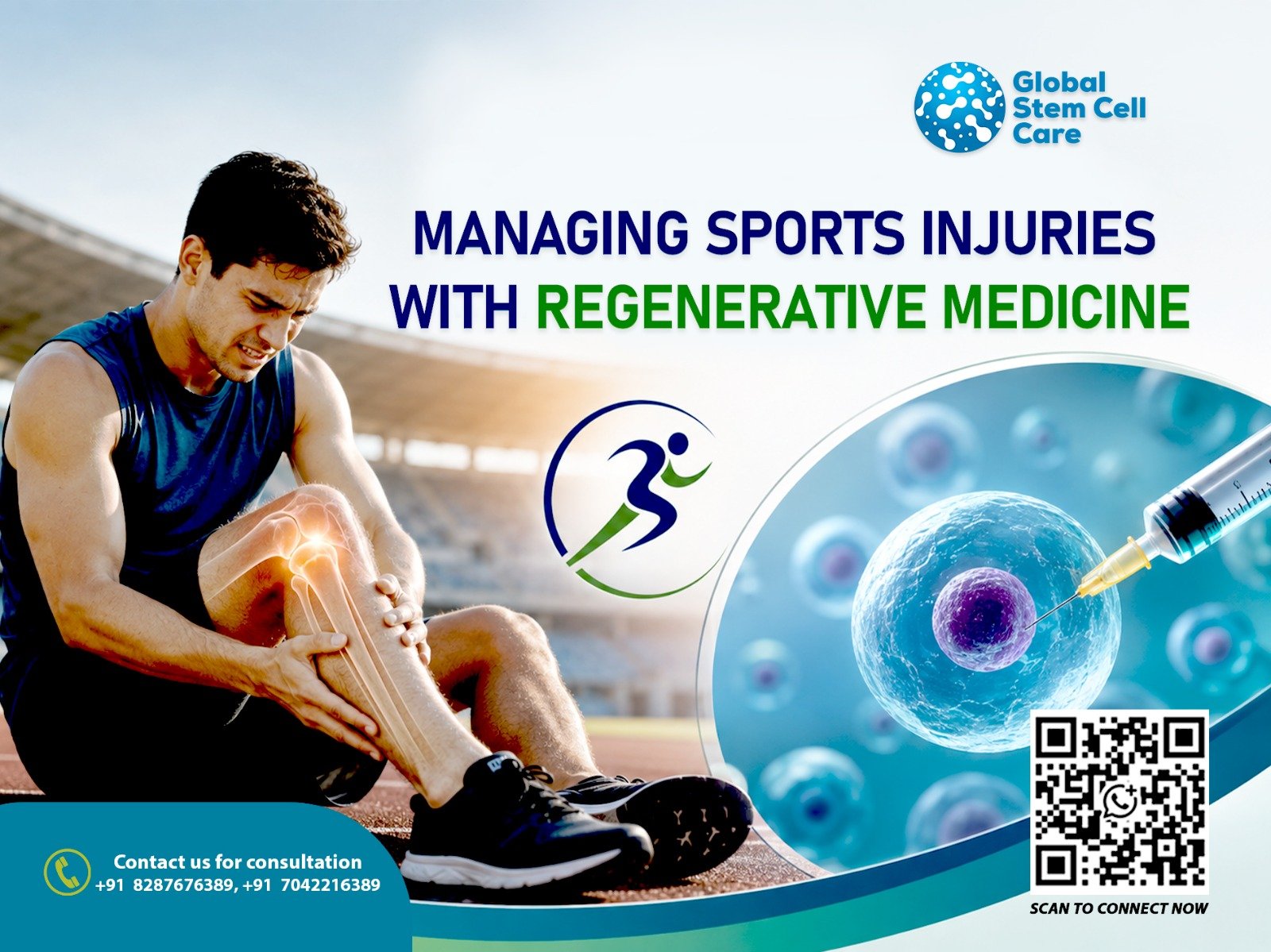
Managing Sports Injuries with Regenerative Medicine
A sports injury can disrupt much more than an athlete’s training. Pain, restricted movement, missed competitions, and uncertainty about returning to activity can make recovery frustrating, particularly when symptoms continue despite rest or rehabilitation.
For an athlete, recovery is about more than reducing pain. They may also want to know whether an approach could support tissue recovery, how their rehabilitation may progress, and when returning to activity might be appropriate. These questions have led researchers to investigate regenerative medicine as a potential approach in managing certain musculoskeletal injuries.
Researchers are investigating approaches such as PRP, mesenchymal stem cells, and exosome-based therapies for different sports injuries. Whether a particular approach has a potential clinical role depends on the injury, the treatment being studied, and the strength of available evidence.
What Is Regenerative Medicine?
Regenerative medicine is a broad field of research exploring biological approaches that may support tissue repair, restoration, or recovery. In sports medicine, researchers are investigating regenerative medicine to understand whether this approach could support recovery from certain sports injuries affecting patients’ muscles, tendons, and other musculoskeletal tissues.
Some approaches, such as PRP, mesenchymal stem cells (MSCs), and exosomes, are being investigated, although the level of evidence varies between treatments and injuries.
How Is Regenerative Medicine Being Studied for Sports Injuries?
Current research examines whether specific biological approaches may support recovery from sports-related tissue injuries. Researchers consider factors such as the affected tissue, injury severity, treatment approach, and clinical outcomes rather than applying the same approach to every injury.
Research is mainly exploring:
- Healing: Whether regenerative approaches may influence processes involved in musculoskeletal tissue recovery.
- Inflammation: Whether specific biological approaches may influence inflammatory processes associated with injury.
- Tissue Environment: How regenerative approaches may influence the biological environment around injured tissue.
- Function: Whether these approaches are associated with meaningful changes in pain, movement, or physical function.
- Patient Selection: Which injury types and patient characteristics may be relevant when evaluating these approaches.
The evidence remains different across therapies and sports injuries, which is why researchers continue to evaluate their safety, effectiveness, and appropriate clinical use.
Platelet-Rich Plasma (PRP) Therapy and Sports Injuries
Platelet-rich plasma (PRP) therapy is a regenerative approach that focuses on recovery using the patient’s own platelets from the blood. After processing, the platelet-rich preparation is administered to the injured area to influence the healing environment.
For sports-related injuries, PRP is being investigated for conditions such as tendinopathy and some tendon or ligament injuries. Researchers have observed various findings, with outcomes varying based on the injury, how PRP is prepared, treatment protocols and rehabilitation plans.
What researchers are examining:
- Pain and Function: Whether PRP treatment has an effect on pain relief and improvement in physical function in specific injuries.
- Tissue Healing: Whether platelet-borne biological agents have an effect on tendon healing.
- Activity: Whether PRP may influence functional outcomes or return to activity when used alongside rehabilitation.
- Treatment Consistency: How variations in the administration of the procedure affect the outcome.
PRP is therefore better understood as an approach being studied for specific sports injuries rather than a universal treatment for athletic injuries.
Stem Cell Therapy in Sports Medicine
Stem cell therapy is another regenerative approach being investigated in sports medicine. Research, particularly involving mesenchymal stem cells (MSCs), is examining how these cells may influence biological processes associated with damaged musculoskeletal tissues.
Among the approaches being studied, mesenchymal stem cells (MSCs) have been the main interest of scientists in stem cell research involving tendons, ligaments, and other connective tissues.
Current research is examining:
- Tissue Response: Researchers are examining how MSC-based approaches may influence biological processes associated with tendon and ligament repair.
- Cell Signalling: The interaction of MSCs with other cells and signalling in response to tissue damage.
- Function: Whether MSC-based approaches may influence movement, physical function, or other clinically relevant outcomes.
- Safety: The ability of these strategies to be employed safely and effectively for selected patients.
Evidence is still specific to the condition, and stem cell therapy for sports injuries must not be viewed as a proven solution for all athletes. More research is required in order to find out where the MSCs might fit into treatment.
Exosome Therapy for Sports Injuries: What Is Being Investigated?
Exosomes are small extracellular vesicles that are released by cells and can carry biological signals between cells. Scientists are studying whether these signals could influence the body’s approach to tissue recovery following sports injuries.
In sports medicine, early research is examining whether exosome-based approaches may influence biological processes involved in tendon and ligament repair. Areas of investigation include:
- Cell Communication: Exosomes and their ability to impact cell-to-cell communication in the process of tissue healing.
- Inflammation: Whether their biological signals can have an effect on inflammation that occurs around the site of injury.
- Repair: Whether exosome-based approaches may influence biological processes involved in tendon and ligament repair.
- Future Application: How findings from current research could eventually inform future clinical applications.
Much of the evidence surrounding exosomes in sports medicine remains preclinical, so findings from laboratory and animal studies should not be interpreted as proof that these therapies are effective in athletes.
Which Sports Injuries Are Being Studied?
Research has focused on several sports-related injuries, particularly conditions involving tissues that can be difficult to manage or recover from. However, the amount and quality of evidence differs considerably between conditions. These are the situations where athletes often start looking for better approaches that go beyond conventional treatments and ask whether newer biological approaches are being investigated.
Current research has shown the greatest interest in conditions such as:
- Tendons: Achilles and patellar tendon conditions are among the tendon injuries being investigated.
- Ligaments: ACL and other ligament injuries are being studied to understand whether regenerative approaches may have a role alongside existing management strategies.
- Shoulder: Rotator cuff injuries are also being investigated in regenerative sports medicine research.
- Cartilage: Selected cartilage and other soft-tissue injuries remain areas of ongoing regenerative medicine research.
The level of evidence varies from one injury to another. While some injuries have been researched more than others, scientists continue to investigate patients, injuries, and methods of regenerative medicine that would provide clinical benefit.
What Should Athletes Know Before Considering Regenerative Medicine?
Before exploring regenerative medicine, athletes must understand that every sports injury needs a personalised assessment before suggesting any treatment. A treatment that may be suitable for one patient or condition may not be suitable for another.
Consider the following before making a treatment decision:
- Diagnosis: the first step is a clear diagnosis that helps determine the nature, severity, and appropriate management for the injury.
- Eligibility: Factors such as injury type, overall health, previous treatment, and clinical findings may influence whether a regenerative approach is appropriate.
- Scientific Evidence: The strength of evidence varies according to the specific regenerative approach and the injury being studied.
- Rehabilitation: A structured rehabilitation programme may remain an important part of recovery, depending on the injury and treatment plan.
- Expectations: Always talk about your expectations in terms of recovery with an experienced healthcare provider.
Considering the clinical assessment and available evidence can help athletes make a more informed treatment decision.
Looking Ahead
If you are dealing with a sports injury that isn’t responding to standard treatment or improving as expected, don’t rely on online information alone. The first step should always be an accurate diagnosis and to discuss all your options with a qualified healthcare professional.
Although regenerative medicine may seem like a possible approach, consider asking about how much clinical evidence there is for a specific injury or whether it fits your recovery goals. Making decisions based on evidence rather than expectations can help you choose the most appropriate path for your recovery.
Frequently Asked Questions
Q1. Who may be a suitable candidate for regenerative medicine in sports injuries?
Suitability depends on factors such as the type of injury, its severity, overall health, previous treatments, and a healthcare professional’s clinical assessment.
Q2. Can regenerative medicine be used for chronic sports injuries?
Researchers are investigating regenerative approaches for certain chronic tendon and ligament injuries, but suitability varies depending on the individual condition and available evidence.
Q3. Is rehabilitation still necessary after regenerative therapy?
Yes. Rehabilitation often remains an important part of recovery, helping restore strength, flexibility, function, and a gradual return to physical activity.
Q4. How do doctors decide whether regenerative medicine is appropriate?
Healthcare professionals consider the diagnosis, imaging findings, medical history, treatment goals, and current clinical evidence before recommending a treatment plan.
Q5. Are regenerative medicine treatments approved for all sports injuries?
No. Regulatory approval and clinical use vary by treatment, condition, and country, and many regenerative approaches for sports injuries remain under investigation.
Reference Links
(1) Cruciani, M., Franchini, M., Mengoli, C., et al. (2019). Platelet-rich plasma for sports-related muscle, tendon and ligament injuries: An umbrella review. Blood Transfusion. Retrieved from
https://pubmed.ncbi.nlm.nih.gov/31846610/
(2) Chalidis, B., Givissis, P., Papadopoulos, P., & Pitsilos, C. (2023). Molecular and Biologic Effects of Platelet-Rich Plasma (PRP) in Ligament and Tendon Healing and Regeneration: A Systematic Review. International Journal of Molecular Sciences. Retrieved from
https://pubmed.ncbi.nlm.nih.gov/36769065/
(3) Koshy, D., Koshy, D. I., & Ooi, E. (2025). Biologic Therapies in the Management of Sports-Related Tendon and Ligament Injuries: A Narrative Review. Cureus. Retrieved from
https://pubmed.ncbi.nlm.nih.gov/40416911/
(4) Xue, Y., Riva, N., Zhao, L., et al. (2023). Recent Advances of Exosomes in Soft Tissue Injuries in Sports Medicine: A Critical Review on Biological and Biomaterial Applications. Journal of Controlled Release. Retrieved from
https://pubmed.ncbi.nlm.nih.gov/37866405/
(5) Tong, Z., Koh, Y. Q., Tan, W. T., et al. (2021). Mesenchymal Stem Cell-Derived Extracellular Vesicles in Tendon and Ligament Repair: A Systematic Review of In Vivo Studies. International Journal of Molecular Sciences. Retrieved from
https://pubmed.ncbi.nlm.nih.gov/34685532/
(6 ) U.S. Food and Drug Administration. (2021). Consumer Alert on Regenerative Medicine Products Including Stem Cells and Exosomes. U.S. Food and Drug Administration. Retrieved from
Medical Disclaimer
This blog is intended for educational and informational purposes only and should not be considered medical advice, diagnosis, or treatment recommendation. Regenerative medicine, including stem cell therapy, platelet-rich plasma (PRP), and other biologic approaches, may not be suitable for every sports injury or patient. Treatment decisions should always be based on an individual medical evaluation, current clinical evidence, and the guidance of a qualified healthcare professional.