Table of Contents
Stem cell therapy for spinal cord injury is an interesting area of research and may offer future options for supporting neurological recovery, but it is not yet an established treatment that reliably restores lost movements or sensation. Researchers are studying whether different cell types may protect surviving nerve cells, influence inflammation and support tissue repair. Outcomes vary, and further well-designed clinical trials are needed to establish safety and effectiveness.
Key Takeaways
- Stem cell therapy for spinal cord injury is an active area of research, but its effectiveness remains uncertain.
- Mesenchymal stem cells (MSCs) and neural stem or progenitor cells are being studied for their potential to support neurological recovery.
- Research explores inflammation control, nerve cell protection, remyelination and improved communication within damaged spinal pathways.
- Recovery depends on injury severity, location, completeness, rehabilitation and individual health factors.
- Stem cell interventions may cause complications and should not replace established medical care or rehabilitation.
- Patients should understand the evidence, regulatory status and risks before considering an experimental intervention.
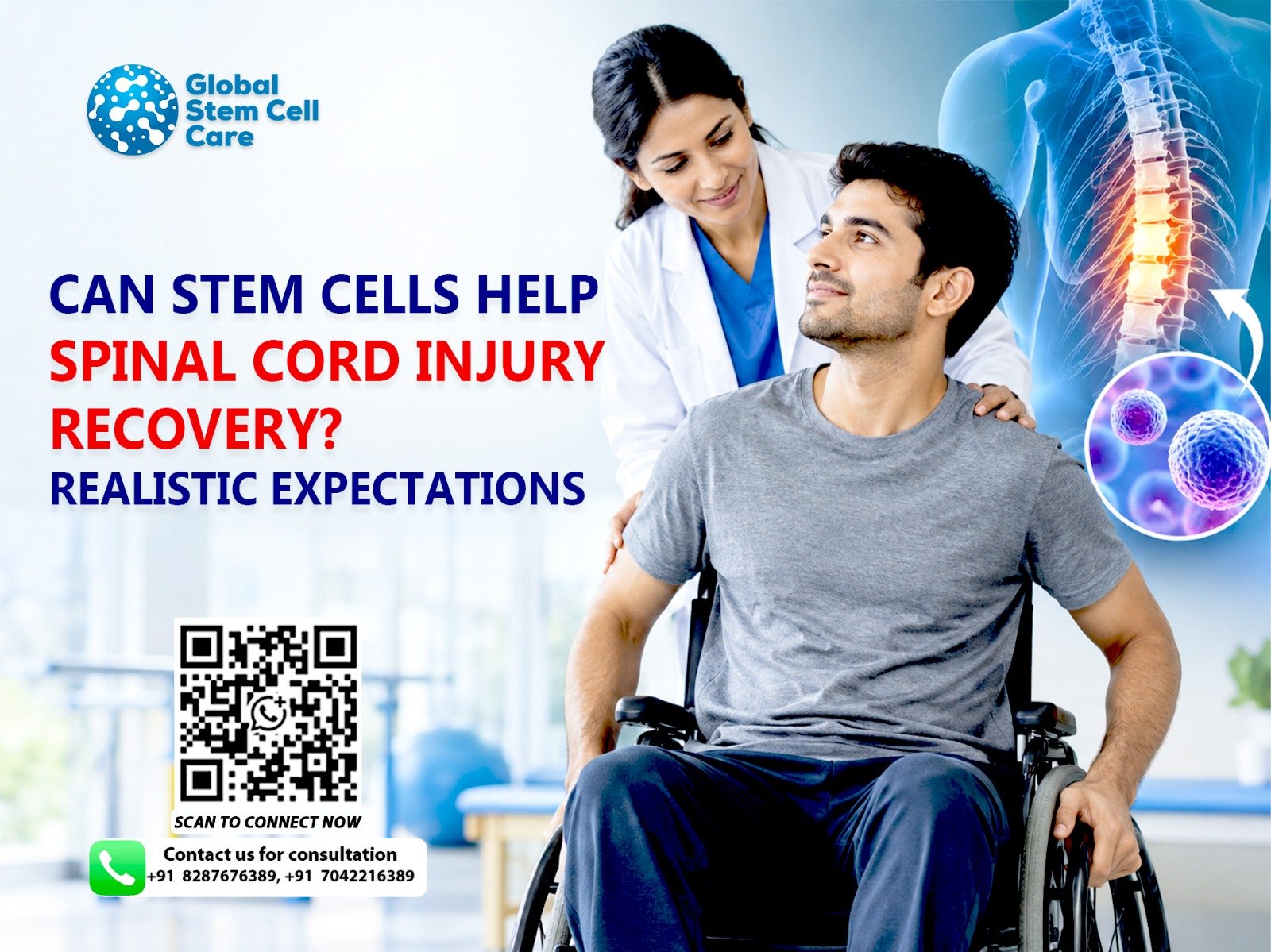
Can Stem Cells Help Spinal Cord Injury Recovery? Realistic Expectations
With spinal cord injury, a person can feel sensation restriction, reduced movement, and may affect on other important bodily functions. The effects depend on the location and severity of the injury, as well as how much nerves tissues that are damaged or remain functional.
Researchers are studying whether stem cells could support recovery by influencing inflammation, protecting survival cells or supporting the repair system in the body. However, these potential effects are still being investigated, and improvements reported in research do not mean that a person may regain the ability to walk or recover lost sensation.
Understanding the science can help patients and families make informed decisions without relying on unrealistic promises.
What Are Stem Cells?
Stem cells have the unique ability to produce more stem cells as well as develop into specific cell types in certain conditions. These cells are responsible for the maintenance of some tissues throughout the lifetime of an organism.
After a person sustains a spinal cord injury, their damaged nerve cells and disrupted connections may interfere with communication between the brain and the body. Researchers are studying the potential of stem cells to support existing cells, influence inflammatory responses, or help replace certain lost or damaged cell populations.
These options are still being studied. Stem cells do not necessarily regrow a working spinal cord, nor is there necessarily any benefit to one’s everyday life because of biological activity alone.
Types of Stem Cells Used in Spinal Cord Injury
Different cell types are being studied, each with distinct properties and safety considerations.
Mesenchymal Stem Cells (MSCs): Mesenchymal stem/stromal cells can be sourced from different sources such as bone marrow or adipose tissue. These cells are still being investigated for their ability to influence inflammation and release biological signalling molecules. Although they are not automatically converted into functioning nerve cells, their effects depend on the product and treatment protocol.
Neural Stem and Progenitor Cells: These types of stem cells can grow into certain nervous system cell types. Researchers are studying whether these cells could replace certain cells or support neural connections. Their safe integration and appropriate cell development remain a part of the active part of research.
Embryonic Stem Cells: Embryonic stem cells have the ability to differentiate into a variety of different cells. Researchers are looking at the possibility that these specialised cells could play a role in the development of new spinal cord repair techniques in the future. It is essential to control the unwanted cell growth and differentiation.
Induced Pluripotent Stem Cells (iPSCs): These cells are created by inducing mature cells back to a stem cell state. The clinical application of these cells needs further study in relation to their genetic stability, immunogenicity, reproducibility, and safety.
There is no cell type that has proven itself as an effective treatment for spinal cord injury.
The Role of Stem Cells in Regenerative Medicine
In regenerative medicine research, scientists focus on finding different approaches to restore or support the function of damaged cells and tissues. In the context of spinal cord injury, cell-based therapy is being studied alongside rehabilitation, biomaterials and other approaches.
Scientists are studying whether stem cells may help influence inflammation, support surviving nerve cells, or eventually replace specific cell populations. Functional recovery may need complex neural connections to form and transmit signals correctly.
What does clinical research show?
In 2025, a review was carried out on current human studies based on stem cell therapy approaches for spinal cord injury. Another review carried out in 2025 involved 30 studies on 656 patients, which showed some improvement in certain parameters. Differences in study designs, cell type, methods of treatment, and participant demographics make it impossible to generalise these results to a single patient.
Further randomised controlled trials with longer follow-up periods are needed to determine which treatments work and for whom.
Challenges in Stem Cell Therapy for Spinal Cord Injuries
Despite ongoing studies in stem cell therapy for spinal cord injuries, scientists face different challenges that must be addressed before the approach may become an established treatment.
- Injury Severity: Recovery often depends on the injury’s location, severity, and timing. Outcomes may vary between patients.
- Cell Survival and Integration: Transplanted cells must survive and function appropriately. Establishing connections with existing nerve cells remains challenging.
- Safety Concerns: Risks may be related to infection, immune response, procedural hazards, and uncontrolled cell proliferation. Close monitoring is crucial.
- Limited Clinical Research: Various types of cells and techniques are used in research. More clinical trials are needed for safety and efficacy.
- Regulations and Therapeutic Claims: Patients should verify clinical trial approval, supporting evidence, costs, and follow-up care before considering an intervention.
According to the ICMR in India, interventions using stem cells for spinal cord injury must only be done through approved clinical trials. Patients must ensure this before undergoing any treatment.
Ethical Considerations in Stem Cell Research
Ethical research needs informed consent, transparent communication, reasonable cell sourcing, and independent oversight. Patients must understand the experimental status of a promising intervention, the available evidence, possible risks, alternatives, and challenges. Such claims offering promising guaranteed recovery or reversal of paralysis should be treated with caution.
Researchers also have to adhere to guidelines related to donor consent, privacy, handling of cells, and clinical trials. In India, relevant guidelines need to be adhered to in terms of regulatory requirements and ethical considerations as well.
Looking Ahead
Stem cell therapy for spinal cord injury may seem a promising approach but remains under investigation, and requiring further more evidence on safety and effectiveness. However, currently medical care and rehabilitation remain an important part of recovery.
A person interested in undergoing such an experimental procedure must seek advice from an experienced specialist and consider all the evidence and possible risks of the intervention.
For more information about the options and any questions about treatment, contact Global Stem Cell Care. Base your decisions on verifiable evidence, not guarantees of success.
Frequently Asked Questions
Q1. Can stem cell therapy restore movement after spinal cord injury?
Some studies have reported improvements in certain results, but current evidence has yet to guarantee restored movement or independent walking.
Q2. Which stem cells are being studied?
Researchers are studying MSCs, neural stem and progenitor cells, embryonic stem cell-derived cells and iPSCs.
Q3. Is stem cell therapy for spinal cord injury approved in India?
ICMR guidance restricts these interventions to appropriately approved clinical trials. Verify current requirements and the specific intervention’s regulatory status.
Q4. What are the potential risks of stem cell therapy?
Risks may include infection, immune reactions, procedure-related complications, and unwanted cell growth. The risk profile depends on the intervention.
Q5. Should rehabilitation continue if a patient considers stem cell therapy?
Yes. Patients should continue appropriate medical care and rehabilitation unless their treating healthcare team advises otherwise.
Reference Links
Sugai K, Nakamura M, Okano H, Nagoshi N. Stem cell therapies for spinal cord injury in humans: A review of recent clinical research. Brain and Spine. 2025.
Retrieved from: https://pmc.ncbi.nlm.nih.gov/articles/PMC11870206/
Troiani Z, et al. Efficacy of Mesenchymal and Embryonic Stem Cell Therapy for the Treatment of Spinal Cord Injury: A Systematic Review and Meta-Analysis of Human Studies. Global Spine Journal. 2025.
Retrieved from: https://pmc.ncbi.nlm.nih.gov/articles/PMC12102082/
Indian Council of Medical Research. Evidence-Based Status of Stem Cell Therapy for Human Diseases. 2021.
Retrieved from: https://www.icmr.gov.in/icmrobject/uploads/Guidelines/1745229591_evidence_based_status_of_stem_cell_therapy_for_human_diseases_v1.pdf
International Society for Stem Cell Research. Guidelines for Stem Cell Research and Clinical Translation.
Retrieved from: https://www.isscr.org/guidelines
Medical Disclaimer
This blog is intended for educational purposes only and does not replace professional medical advice, diagnosis, or treatment. Stem cell therapy for spinal cord injury remains investigational, and its potential outcomes and risks vary. Patients should consult qualified healthcare professionals before making treatment decisions and should not delay or discontinue recommended medical care or rehabilitation based on information presented here.