Table of Contents
- Key Takeaways
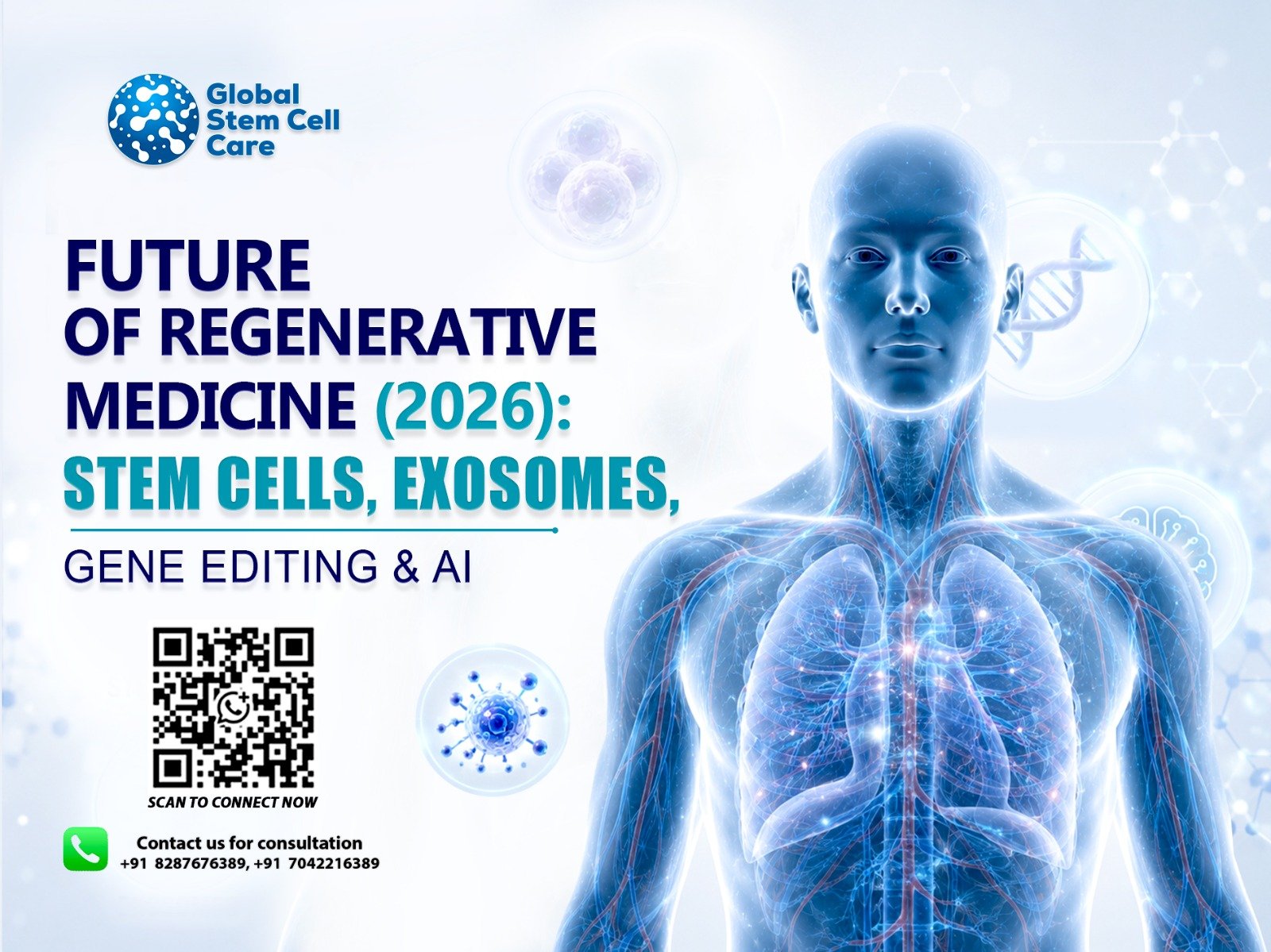
- Future of Regenerative Medicine (2026): Stem Cells, Exosomes, Gene Editing & AI
- Stem Cells: Moving Towards More Personalised Regenerative Medicine
- Exosomes: Why Cell-Free Therapies Are Gaining Attention
- Gene Editing: Expanding the Possibilities of Precision Medicine
- Artificial Intelligence: Driving Smarter Regenerative Medicine Research
- The Future Lies in Combining These Technologies
- Looking Ahead
- Frequently Asked Questions
- Reference Links
The future of regenerative medicine will continue to be shaped by several evolving technologies that aim to improve how diseases are understood, managed, and potentially treated. Current research is exploring how stem cells, exosomes, gene editing, and artificial intelligence (AI) may complement one another to enable more personalised, precise, and data-driven approaches to patient care. While these advancements have gained significant scientific interest, many applications remain under investigation and require further clinical research to establish their long-term safety, effectiveness, and appropriate use in routine medical practice.
Key Takeaways
- Regenerative medicine is evolving through advances in stem cell research, exosome-based therapies, gene editing, artificial intelligence (AI), and related technologies.
- Researchers are exploring how these innovations may work together to support more personalised and evidence-based approaches to healthcare.
- AI is helping accelerate research, improve clinical data analysis, and support treatment planning, while continuing to complement—not replace—medical expertise.
- Gene editing and exosome research continue to expand scientific understanding, although many applications remain in the experimental or early clinical stages.
- Future progress will depend on high-quality clinical trials, regulatory oversight, long-term safety data, and continued scientific collaboration.
- Except for approved hematopoietic stem cell transplantation (HSCT) applications, most stem cell-based regenerative therapies remain investigational and should only be considered within applicable regulatory and ethical guidelines.
Medically Reviewed By
Written By
Nishat Arfin
Scientific Review By
Tabish Iqbal
Medically Approved By
Global Stem Cell Care Medical Team
Last Reviewed: July 2026
Future of Regenerative Medicine (2026): Stem Cells, Exosomes, Gene Editing & AI
Regenerative medicine is evolving beyond the study of individual therapies. In 2026, scientific progress is actively being driven by the convergence of stem cell research, extracellular vesicles such as exosomes, gene-editing technologies, artificial intelligence (AI), and advanced biomaterials. Instead of developing these innovations separately, researchers are investigating how they may complement one another to enable more precise, personalised, and evidence-based healthcare.
This shift reflects a broader change in regenerative medicine. In which scientists, alongside their research into new therapies, focus on improving manufacturing practices, developing clinical evidence, treatment optimisation, and long-term safety for patients. All these aspects will ensure further advancement of clinical translation in the field.
Although these technologies have generated significant scientific interest, many applications continue to be evaluated through ongoing research and clinical studies. In this way, it becomes important to know the current state of affairs and see the directions for further research to make a realistic assessment of future developments.
Stem Cells: Moving Towards More Personalised Regenerative Medicine
Stem cell research continues to shape regenerative medicine, but its focus is evolving. Rather than simply developing new therapies, researchers are studying to improve treatment precision, strengthen clinical evidence, and better understand which patients may benefit most. Current research focuses on making stem cell-based approaches safer, more consistent, and better supported by scientific evidence.
Current areas of progress include:
- More Personalised Treatment: Researchers are investigating how patient characteristics such as disease type, severity, and overall health may influence treatment response to support more personalised care.
- Higher Manufacturing Standards: Some advancements in cell processing and quality control aim to improve consistency, safety, and reproducibility across different future clinical studies.
- Next-Generation Technologies: Scientists are investigating how stem cells may be combined together with biomaterials, tissue engineering, and advanced delivery systems to support regenerative medicine research.
- Stronger Clinical Evidence: Some large clinical trials continue to study long-term safety, effectiveness, and where stem cell-based therapies may fit into future evidence-based practice.
Instead of just concentrating on new discoveries, current research is helping build the scientific foundation for more precise and personalised regenerative medicine.
Exosomes: Why Cell-Free Therapies Are Gaining Attention
Although stem cells remain an important focus of regenerative medicine, researchers are also beginning to show interest in exosomes as a supportive approach. Instead of introducing living cells into the body, exosome-based research investigates whether naturally released extracellular vesicles can deliver biological signals that support communication between cells.
This cell-free strategy has gained more and more scientific interest because it may help address some of the practical challenges associated with cell-based therapies.
Researchers are currently exploring several possibilities:
- Supporting Natural Cell Communication: Exosomes carry proteins, lipids, and genetic material that allow cells to exchange biological information. Scientists are studying how these signals may influence tissue response in different research settings.
- Expanding Therapeutic Possibilities: As exosomes are cell-free, researchers are investigating whether they could be tailored for a broader range of regenerative medicine applications while maintaining consistent product quality and delivery.
- Improving Drug Delivery Strategies: Some emerging areas of research are whether engineered exosomes could help as targeted delivery vehicles for therapeutic molecules, allowing treatments to reach specific tissues more precisely.
- Advancing Translational Research: With continuing progress from laboratory studies to preliminary clinical investigations, investigators are striving to gain an understanding of areas in which exosomes would help regenerate therapies currently being used.
Although exosome research is advancing rapidly, important questions about safety, standardisation, and clinical effectiveness remain under investigation.
Gene Editing: Expanding the Possibilities of Precision Medicine
Gene editing is another advanced direction in regenerative medicine, allowing researchers to study and modify specific genetic changes associated with disease. Instead of focusing only on repairing damaged tissues, this approach aims to better understand the underlying genetic factors that influence how diseases develop and respond to treatment.
Current areas of scientific interest include:
Correcting Disease-Causing Genetic Variants
Research is also exploring the possibility of using tools like CRISPR to fix mutations in certain genes that cause hereditary diseases. These techniques still need to be tested for their safety, accuracy, and long-term impacts.
Enhancing Stem Cell Studies
Researchers are also using gene editing to better understand stem cell behaviour and improve cellular characteristics in research settings.
Supporting Personalised Medicine
Gene editing could prove useful in future studies that would discover genetic variations in people that impact how they react to therapies and how personalised medicine approaches can be used.
Increasing Precision and Safety
Increasing accuracy in the gene editing process and minimising the risk of unintentional genetic changes is a major area of interest for researchers.
While gene editing has transformed biomedical research, the majority of regenerative medicine uses are still in the experimental phase. The future success of these procedures will be determined by clinical studies, rigorous safety analysis, and ethics regulation.
Artificial Intelligence: Driving Smarter Regenerative Medicine Research
Currently, artificial intelligence (AI) is becoming an important tool in supporting regenerative medicine by helping researchers analyse complex biological data, identify meaningful patterns, and support scientific discovery. Instead of replacing doctors, AI helps to improve research efficiency and strengthen evidence-based decision-making.
Current areas of focus include:
- Faster Data Analysis: With the help of artificial intelligence, data sets of clinical and biological nature can be processed, thus allowing researchers to detect trends related to regenerative medicine research.
- Personalised Approach Facilitation: The way AI can aid researchers to analyse personalised data in order to develop more personalised treatment plans is currently being researched.
- Enhancing Clinical Research: AI is also helping improve clinical trial design, analyse research outcomes, and identify patterns across large biological datasets, supporting more efficient regenerative medicine research.
As research continues to evolve, AI is expected to remain an important supporting technology that complements scientific expertise and accelerates regenerative medicine research.
The Future Lies in Combining These Technologies
The future of regenerative medicine is unlikely to depend on a single technology—it will be dependent on the use of stem cells, exosomes, gene editing, artificial intelligence, and other emerging technologies. Scientists have become increasingly interested in how these innovations can work together in helping to provide personalised medicine and enhance the precision of treatments. Research continues to develop, and collaboration across multiple scientific and clinical disciplines will continue to play an important role in ensuring that innovations translate into clinical practice based on scientific evidence.
Looking Ahead
The future of regenerative medicine continues to be shaped by scientific research, technological innovation, and responsible clinical translation. While stem cells, exosomes, gene editing, and AI are creating new possibilities in healthcare, many applications are still being evaluated through ongoing research. As new evidence comes to light, staying informed through reliable scientific sources and discussions with qualified healthcare professionals will help patients better understand how these advancements may influence future medical care.
Frequently Asked Questions
Q1. What is the future of regenerative medicine expected to focus on?
Future research is expected to focus on personalised therapies, advanced regenerative technologies, stronger clinical evidence, and improved patient outcomes.
Q2. Will stem cells remain important in regenerative medicine?
Yes. Stem cell research remains an important area of regenerative medicine, with ongoing efforts to improve treatment accuracy, safety, and clinical effectiveness.
Q3. Why are exosomes receiving increased scientific attention?
Scientists have been investigating exosomes because of the important role they may play in cell communication and their possible utilisation in regenerative medicine in a cell-free form.
Q4. How is artificial intelligence supporting regenerative medicine?
AI supports regenerative medicine by analysing complex biological data, improving clinical research, and assisting evidence-informed decision-making.
Q5. Are these emerging technologies already part of routine medical practice?
There are still many applications using stem cells, exosomes, gene editing, and artificial intelligence that are still being investigated and may become part of routine clinical practice as further scientific evidence becomes available.
Reference Links
(1) National Institute of Biomedical Imaging and Bioengineering (NIBIB). Regenerative Medicine. Retrieved from:
https://www.nibib.nih.gov/science-education/science-topics/regenerative-medicine
(2) Kalluri, R., & LeBleu, V. S. (2020). The Biology, Function, and Biomedical Applications of Exosomes. Science, 367(6478). Retrieved from:
https://www.science.org/doi/10.1126/science.aau6977
(3) Pegtel, D. M., & Gould, S. J. (2019). Exosomes. Annual Review of Biochemistry, 88, 487–514. Retrieved from:
https://pubmed.ncbi.nlm.nih.gov/31220978/
(4) Doudna, J. A., & Charpentier, E. (2014). The New Frontier of Genome Engineering with CRISPR-Cas9. Science. Retrieved from:
https://www.science.org/doi/10.1126/science.1258096
(5) International Society for Stem Cell Research (ISSCR). The ISSCR Guide to Stem Cell Treatments. Retrieved from:
https://www.isscr.org/s/ISSCR_PatientHandbook_v12_Feb2024_Redesign_v4b.pdf
(6) Indian Council of Medical Research (ICMR) & Department of Biotechnology (DBT). National Guidelines for Stem Cell Research (2017). Retrieved from:
https://main.icmr.nic.in/sites/default/files/guidelines/Guidelines_for_Stem_Cell_Research_2017.pdf
Medical Disclaimer: This blog is intended for educational purposes only and should not be considered medical advice or treatment recommendations. Stem cells, exosomes, gene editing, artificial intelligence, and other regenerative medicine technologies continue to evolve through scientific research, and many applications remain investigational. Except for approved hematopoietic stem cell transplantation (HSCT), most stem cell-based regenerative therapies should only be considered within applicable regulatory and ethical guidelines. Always consult a qualified healthcare professional before making decisions about regenerative medicine treatments or participation in clinical research.