Table of Contents
- Key Takeaways
- Current Scientific Evidence on Exosome Therapy: What Is Known and What Is Still Being Studied
- Why Are Exosomes Being Studied in Regenerative Medicine?
- What Does Current Scientific Evidence Show?
- What Are the Current Challenges and Limitations of Exosome Therapy?
- How Could Future Research Shape Exosome Therapy?
- Looking Ahead
- Frequently Asked Questions
- Reference Links
Exosome therapy is currently being investigated as a potential approach in regenerative medicine because exosomes may support cell-to-cell communication, tissue repair, and immune regulation. While laboratory research and early-stage clinical studies have reported encouraging findings in selected conditions, important questions remain regarding long-term safety, manufacturing standards, optimal dosing, and clinical effectiveness. As a result, exosome therapy remains investigational for most medical applications and requires further high-quality clinical research before it can become part of routine medical practice.
Key Takeaways
- Exosomes are small extracellular vesicles that enable communication between cells and are being widely studied in regenerative medicine.
- Current research is investigating whether exosome therapy may support tissue repair, reduce inflammation, and influence immune responses in selected conditions.
- Most evidence comes from laboratory research, animal studies, and early-stage clinical trials, with larger human studies still needed.
- Researchers continue to study important challenges such as manufacturing standards, dosage, quality control, long-term safety, and consistent clinical outcomes.
- Except for approved hematopoietic stem cell transplantation (HSCT) applications, most cell-based regenerative therapies, including exosome-based approaches, remain investigational and should only be considered within applicable regulatory and ethical guidelines.
- Patients should rely on evidence-based information and discuss investigational therapies with qualified healthcare professionals before making treatment decisions.
Medically Reviewed By
Written By
Nishat Arfin
Scientific Review By
Tabish Iqbal
Medically Approved By
Global Stem Cell Care Medical Team
Last Reviewed: July 2026
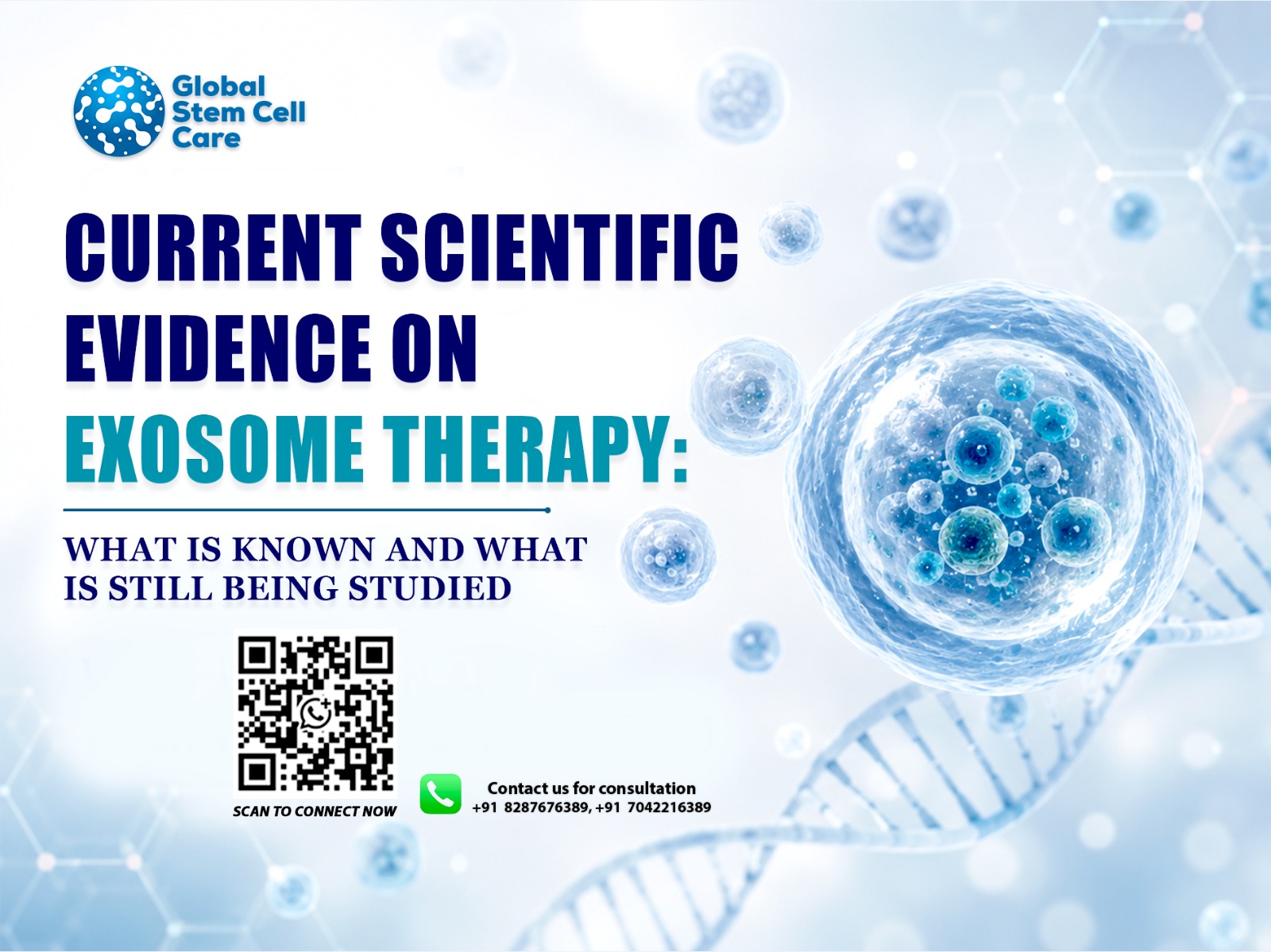
Current Scientific Evidence on Exosome Therapy: What Is Known and What Is Still Being Studied
Exosome therapy has become one of the fastest-growing areas of regenerative medicine research, with researchers studying if these naturally occurring extracellular vesicles may support tissue repair, influence immune response in the body, and facilitate communication between cells. As scientific understanding continues to evolve, exosomes are being investigated for different medical conditions, including musculoskeletal disorders, neurological disease, cardiovascular conditions and other chronic conditions. However, much research remains in the experimental phase.
Despite positive preliminary outcomes from lab studies as well as some clinical trials, there are still issues concerning standardisation of the treatment, production quality, proper dose administration, safety, and efficacy of exosomes in clinical practice. Such concerns indicate that exosome treatment has not yet become a regular therapeutic option for diseases.
Understanding what is known about exosomes currently, what evidence is lacking, and what needs to be answered in the future will allow the patient to understand new information with more realistic expectations.
Why Are Exosomes Being Studied in Regenerative Medicine?
Exosomes are small extracellular vesicles that are naturally produced by several types of cells. Instead of becoming new cells themselves, they carry important proteins, lipids, and genetic material that help cells communicate with one another. Researchers believe that communication may influence how tissues respond to injury, inflammation, and repair, which has made exosomes an interesting area of investigation in regenerative medicine.
Current research has focused on exosomes for several reasons:
Supporting Cell-to-Cell Communication
Exosomes carry biological signals between cells, helping researchers understand how they may influence cellular activities involved in tissue maintenance and repair.
Potential Cell-Free Therapeutic Approach
Unlike stem cell therapy, exosome-based approaches do not involve transplanting living cells. Scientific evidence suggests studying whether this cell-free strategy may provide enough practical benefits while still delivering biological signals that may support regenerative processes.
Influencing Inflammation and Immune Responses
Pre-clinical research shows that exosomes might be involved in modulating the inflammatory and immune response. The possible applications of this characteristic are under investigation for future use in regenerative medicine.
Broad Research Across Multiple Conditions
Currently, exosomes are investigated in many different fields of study, ranging from neurodegenerative diseases to musculoskeletal injuries, cardiovascular problems, skin and wound regeneration, and autoimmune disorders. Nevertheless, the evidence base is varied among these applications.
Although these findings have gained considerable attention from scientists, they are still working to determine how exosome-based therapies can be standardised, evaluated, and translated into safe and effective clinical practice.
What Does Current Scientific Evidence Show?
Studies around exosome therapy have evolved quickly over the years, with investigations ranging from laboratory experiments and animal models to initial-stage human clinical trials. While several findings reported by scientists have been encouraging in some areas, the level of evidence varies depending on the medical condition being studied. Many applications still need further, well-designed clinical trials before firm conclusions can be drawn.
Current research is exploring several areas:
- Musculoskeletal Conditions: One of the areas researchers are focusing on is musculoskeletal conditions to see whether exosomes may support healing in conditions involving cartilage, tendons, bones, and joints. Initial studies have shown potential improvements in tissue repair and functional recovery, but clinical evidence remains limited.
- Neurological Disorders: In neurological disorders, exosomes are being studied for their potential role in delivering biological signals that may influence nerve protection and recovery. Several pieces of evidence currently come from preclinical research, with human studies still remaining at an early stage.
- Wound Healing and Skin Repair: There are several studies that are currently testing whether exosomes can assist in wound healing through the regulation of inflammation, regeneration of tissues, and formation of blood vessels. Researchers are still studying their efficacy for various types of wounds.
- Autoimmune and Inflammatory Diseases: Research is also being conducted on how exosomes may be able to modulate the immune response in some specific autoimmune and inflammatory diseases. Yet again, these uses are still under investigation and require further evidence from clinical trials.
It is important to note that these discoveries reveal the increasing scientific interest in exosome treatment, but they are not evidence of the efficacy of exosome therapy for all indications.
What Are the Current Challenges and Limitations of Exosome Therapy?
Even with encouraging outcomes from laboratory research and early clinical studies, many scientific and regulatory challenges still may need to be addressed before exosome therapy can become part of routine medical practice. Researchers are still investigating how to ensure that exosome-based therapies are safe, consistent, and supported by better clinical evidence.
Some of the key challenges include:
Lack of Standardised Manufacturing
- Exosomes can be isolated from different cell types and produced using different laboratory methods.
- Researchers are investigating to establish standard manufacturing and quality control processes to ensure consistent products for different studies.
Uncertainty Around Dosage and Administration
- There is no standard accepted guidance on the most appropriate dose, frequency, or method of delivering exosome therapy.
- These factors remain part of continuous evaluation through ongoing clinical research.
Limited Long-Term Clinical Evidence
- Early studies have reported encouraging outcomes. Many have involved small numbers of participants or short follow-up periods.
- Larger, long-term clinical trials are needed to better understand treatment outcomes and safety over time.
Regulatory and Quality Considerations
- There are ongoing efforts by regulatory agencies regarding the classification, production, and monitoring of exosome-containing products.
- There is a need for proper regulation, as this is vital in ensuring patient safety and quality of investigational products.
These challenges do not diminish the scientific potential of exosome therapy. Instead, they highlight the need for continued research before broader clinical use can be considered.
How Could Future Research Shape Exosome Therapy?
Future research aims to answer important scientific questions while improving how exosome-based therapies are developed, evaluated, and translated into clinical practice.
Current research priorities include:
Personalised Treatment Strategies
Researchers are focusing on whether exosome-based therapies may be personalised according to a patient’s medical condition, disease stage, or biological properties to support more personalised treatment approaches.
Combination Approaches
Scientists are exploring whether exosomes may support other regenerative medicine strategies, such as biomaterials, tissue engineering, or rehabilitation programmes, to improve clinical outcomes in selected conditions.
Biomarkers for Diagnosis and Monitoring
In addition to their therapeutic potential, exosomes are also being investigated as biomarkers that may help detect disease earlier, monitor disease progression, or assess how patients may respond to treatment.
Larger Clinical Studies
Future multi-centre clinical trials will be vital in order to prove safety, assess efficacy under various conditions, and find out whether certain patients will benefit from the treatment using exosomes.
As science progresses further, these trials will contribute greatly to the elucidation of the future application of exosome therapy within regenerative medicine, while at the same time making sure that medical guidelines are always based on solid scientific facts.
Looking Ahead
Exosome therapy continues to be actively investigated as a type of regenerative medicine, with research expanding across different types of medical conditions. Some current scientific evidence has shown valuable insights into its potential, but unanswered questions remain before exosome-based therapies can become part of routine clinical practice.
As new clinical studies come to light, understanding the difference between ongoing research and well-established medical evidence will help patients have informed discussions with qualified healthcare professionals, so that decisions are based on the latest scientific knowledge rather than expectations.
Frequently Asked Questions
Q1. Is exosome therapy approved as a standard treatment for all medical conditions?
No. Exosome therapy is still an investigational approach for most medical applications. Although research continues to progress, larger clinical studies are still needed before it can become part of routine medical practice for many conditions.
Q2. How is exosome therapy different from stem cell therapy?
Stem cell therapy often involves the use of living cells found in the body, whereas exosome therapy investigates the biological vesicles released by cells. Although both approaches are studied under regenerative medicine, they differ in their mechanism and current research focus.
Q3. Are exosome therapies currently being studied in clinical trials?
Yes. Some researchers are conducting clinical trials to evaluate the safety, effectiveness, and potential applications of exosome-based therapies for different medical conditions. However, the level of evidence still varies between diseases.
Q4. Why do research findings sometimes differ between studies?
Different exosomes’ origins, lab protocols, research designs, patient groups, and duration of follow-up may affect research results. This is one of the reasons why large-scale and standardised clinical studies are still necessary.
Q5. Where can patients find reliable information about exosome therapy?
Patients should use scientific literature, credible organisations in the field of medicine and qualified healthcare professionals to obtain information about exosome therapy instead of relying only on ads or unreliable Internet sites.
Reference Links
(1) Pegtel, D. M., & Gould, S. J. (2019). Exosomes. Annual Review of Biochemistry, 88, 487–514. Retrieved from
https://pubmed.ncbi.nlm.nih.gov/31220978/
(2) Kalluri, R., & LeBleu, V. S. (2020). The Biology, Function, and Biomedical Applications of Exosomes. Science, 367(6478). Retrieved from
https://www.science.org/doi/10.1126/science.aau6977
(3) Yu, B., Zhang, X., & Li, X. (2024). Clinical Status of Exosome Therapy: Current Evidence, Challenges, and Future Perspectives. Cell Transplantation. Retrieved from
https://journals.sagepub.com/doi/10.1177/15563316251362179
(4) Zhang, Y., Li, M., Hu, C., et al. (2025). Current Advances in Exosome-Based Regenerative Medicine: Therapeutic Applications and Future Directions. Frontiers in Medicine. Retrieved from
https://www.frontiersin.org/journals/medicine/articles/10.3389/fmed.2025.1539714/full
(5) International Society for Stem Cell Research (ISSCR). (2024). The ISSCR Guide to Stem Cell Treatments. Retrieved from
https://www.isscr.org/s/ISSCR_PatientHandbook_v12_Feb2024_Redesign_v4b.pdf
(6) Indian Council of Medical Research (ICMR) & Department of Biotechnology (DBT). (2017). National Guidelines for Stem Cell Research. Retrieved from
https://main.icmr.nic.in/sites/default/files/guidelines/Guidelines_for_Stem_Cell_Research_2017.pdf
Medical Disclaimer: This blog is intended for educational purposes only and should not be considered medical advice or treatment recommendations. Exosome therapy is an active area of scientific research, and many of its potential applications remain investigational. Current evidence continues to evolve, and treatment suitability depends on an individual’s medical condition, clinical assessment, and applicable regulatory guidance. Except for approved hematopoietic stem cell transplantation (HSCT), most stem cell-based regenerative therapies remain investigational and should only be considered within regulated clinical research settings. Always consult a qualified healthcare professional before making decisions about exosome therapy or any other regenerative medicine treatment.