Table of Contents
Summary: PRP and stem cell therapy are two of the best and leading regenerative treatments for joint pain, each offering unique benefits of its own. This guide explains how they differ, who they suit best, and how to choose the safest and most effective option.
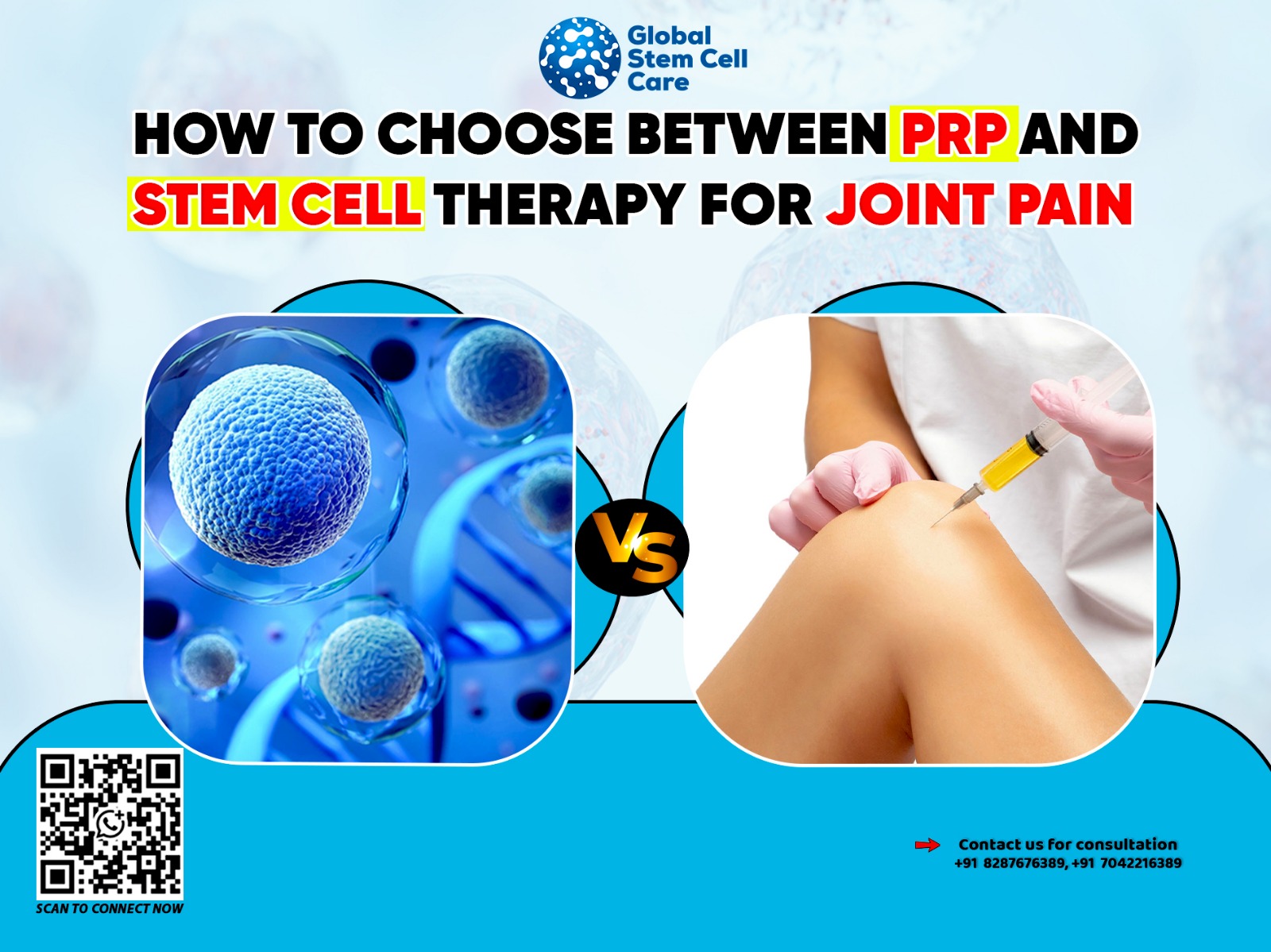
How to Choose Between PRP and Stem Cell Therapy for Joint Pain?
Many patients suffer from joint pain, often making simple tasks like climbing stairs or walking long distances hard and limiting. When medicines, physiotherapy, or injections often lead to only temporary relief, many patients start exploring regenerative options like Platelet-Rich Plasma (PRP) and stem cell therapy in India.
Both treatments are based on natural healing, but they are not the same. Understanding their differences can help you make a clearer, more confident decision about which option is right for your joint condition. Let’s explore in simple language so you can make an informed decision to choose what aligns with your health needs.
What Are PRP and Stem Cell Therapy?
1. Platelet-rich Plasma (PRP)
PRP therapy is a simple, minimally invasive treatment made from your own blood. After a quick processing step, the plasma becomes concentrated with the ability to grow factors that help decrease inflammation and encourage tissue repair.
PRP is commonly renowned and used for:
- Early osteoarthritis
- Mild cartilage wear
- Tendon or ligament irritation
- Sports injuries
2. Stem Cell Therapy
Stem cell therapy uses stem cells that can support regeneration at a deep level. These cells have the ability to transform into cartilage, bone, or soft tissue, and they release healing signals that help decrease inflammation and promote recovery.
Stem cells are often used for:
- Moderate to severe joint degeneration
- Cartilage defects
- Long-term osteoarthritis
- Soft tissue injuries that have not healed with other treatments
Both treatments aim to support your body’s healing abilities, just in different ways.
PRP vs. Stem Cell Therapy: Simple Comparison
| Factors | PRP Therapy | Stem Cell Therapy |
| Source | Your own blood. | It is derived from bone marrow or fat tissue. |
| Main Action | Reduce inflammation and boost healing signals. | Repairs cells, reduces inflammation, and supports restoration. |
| Ideal for | Mild to moderate joint pain. | Moderate to severe degeneration. |
| Procedure Duration | 30 to 60 minutes. | 1-3 hours depending on type. |
| Session Required | Often requires 2-4 sessions. | It usually takes 1-2 sessions. |
| Cost | Lower | Moderate, depending on the condition. |
| Recovery Time | Short and minimal downtime. | Gradual improvements over weeks to months. |
| Evidence Strength | Strong and early osteoarthritis. | Promising for advanced degeneration. |
| Pain Relief | Weeks | Weeks to months. |
How to Choose the Right Treatment for Your Joint Condition?
Here are some key points to consider to choosing the right treatment for your joint pain:
- Understand the Severity of Your Joint Condition
- PRP is often effective in mild to moderate joint pain, enabling the easing of pain by soothing the inflammation.
- Depending on the degree of cartilage loss involved or chronic degeneration associated with your condition, stem cell therapy may provide deeper, more regenerative support.
- Identify Your Treatment Goals
- If you aim to achieve short- to mid-term pain relief and improved movement, then PRP may be a good fit.
- Overall, if you are looking for structural repair, long-term healing, or support for worn-out tissue, then stem cell therapy fits the bill for your expectations.
- Consider Age & Overall Health
- Your response is influenced by age, long-standing joint issues, and your general health.
- Indeed, the regenerative potential of stem cells can be more effective in older adults or those suffering from chronic degeneration.
- Consider Budget & Accessibility
- Because PRP is minimally processed, it usually tends to be less costly.
- Therapy with stem cells is more advanced, involves specialized laboratories, and is thus a higher investment; generally, it takes longer.
- Compare Recovery Timelines
- PRP has minimal downtime and a fast recovery.
- While these results may take longer with the assistance of stem cell therapy, the improvements can continue steadily for months.
For Expert Advice & Consultation
A clearer understanding of the options helps in decision-making about joint care. PRP and stem cell therapy are different kinds of treatments, but to choose the right kind of treatment, proper evaluation is required.
For safe, supportive, and personalized guidance, expert consultation is provided at Global Stem Cell Care to empower you toward moving forward with confidence and clarity.
The Concluding Thoughts
Deciding whether to go for PRP or stem cell therapy is largely dependent on the state of your joints, your objectives, and the amount of money you have. Once you have been properly assessed and have the backing of a specialist, you will be able to opt for a treatment that corresponds to your requirements and leads you to the restoration of joint health that lasts.
Frequently Asked Questions(FAQs)
Q1. Which is better, stem cells or PRP?
Ans. None of the methods can be considered as a “better” one in general. PRP is usually recommended for mild to moderate joint pain, whereas stem cell injection may be suggested for deeper tissue damage or advanced degeneration.
Q2. Is stem cell therapy better than PRP for knees?
Ans. PRP may be very effective in the case of early knee arthritis. In the case of cartilage loss, chronic inflammation, or advanced knee degeneration, stem cell therapy is usually regarded as a more potent regenerative option.
Q3. What are the disadvantages of using stem cells to treat arthritis?
Ans. Stem cell treatment may be more costly, take longer to recover from, and have results that vary based on the severity of arthritis and individual health. For safety, it needs to be done only at an accredited center.
Q4. Are stem cells more expensive than PRP?
Ans. Yes. Stem cell therapy typically costs more because it involves advanced processing, specialized labs, and higher biological complexity compared to PRP.
Reference Links
For stem cell treatment: https://www.aboutstemcells.org/info/nine-things-to-know-about-stem-cell-treatments
Types of stem cell treatment: https://www.aboutstemcells.org/info/what-are-stem-cell-treatments
Pittenger MF et al.
Multilineage potential of adult mesenchymal stem cells.
Foundational evidence for cartilage, bone, and soft-tissue regeneration
https://pubmed.ncbi.nlm.nih.gov/10521347/
Journal of Clinical Medicine (MDPI)
PRP for mild to moderate knee osteoarthritis: Clinical outcomes.
https://www.mdpi.com/2077-0383/8/9/1359
Frontiers in Medicine
Platelet-rich plasma for musculoskeletal disorders.
https://www.frontiersin.org/articles/10.3389/fmed.2020.00127/full
Lamo-Espinosa JM et al.
Intra-articular MSC injections for knee osteoarthritis – RCT.
https://pubmed.ncbi.nlm.nih.gov/28961506/
Gadelkarim M et al.
Adipose-derived MSC therapy for osteoarthritis: Systematic review.
https://stemcellres.biomedcentral.com/articles/10.1186/s13287-022-02805-3
Uccelli A et al.
Immunomodulatory effects of MSCs in chronic inflammatory conditions.
https://pubmed.ncbi.nlm.nih.gov/18055458/