Table of Contents
Summary: Regenerative medicine is indeed changing the purely cell-based mindset toward a more refined, signal-based approach. Exosomes derived from stem cells are now being actively studied for their role in biological communication and tissue support. This blog explains how stem cells and exosomes are different and why these approaches are increasingly relevant in modern regenerative care
For many years, scientists have been meticulously researching and studying regenerative medicine, such as stem cells and exosomes, for their potential and more ethical uses. While stem cells allow the body to heal, which opened many possibilities, real-world clinical experiences revealed that healing is far more complex. Patients often demonstrated a variety of results, influenced not only by the cells themselves but also by inflammation, immune response, and tissue environment.
As research deepened, scientists came to understand that the regenerative ability of stem cells is produced by the biological signals they release. This discovery puts exosomes at the center of attention in regenerative research. Today, regenerative care is no longer about choosing one over the other but understanding the biological context.
Understanding Regenerative Medicine at the Body Level
In simple words, regenerative medicine focuses on supporting and boosting the body’s natural repair mechanism rather than replacing damaged tissues outright. Without forcing regeneration, modern approaches attempt to:
- Regulate inflammation that blocks healing
- Support cellular communication
- Improve the tissue microenvironment
- Encourage gradual functional recovery
This work explains why signaling molecules are becoming as essential as cells themselves.
Stem Cells: In Clinical Regenerative Care
Stem cells are undifferentiated cells that have the potential to offer repair through a multitude of mechanisms. In controlled research, stem cells are investigated for their potential to:
- Regulate immunological reactions
- Release growth factors and cytokines
- To support damaged tissue indirectly
- Enhance healing environments
In particular, stem cells not only function by directly replacing damaged tissues. Their main impact comes from the biological message they send, not tissue regeneration.
Exosomes: Why Are They Important?
Exosomes are microscopic extracellular vesicles secreted by cells, including stem cells. They serve as biologic messengers and transmit the following:
- Proteins
- RNA and microRNA
- Growth and regulatory signals
Unlike stem cells, exosomes are cell-free. They do not divide, move, or change. They are purely communicative, which involves telling other cells how to react to injury, inflammation, or stress.
This signaling role is why exosomes are being studied in controlled research settings rather than marketed as standalone cures.
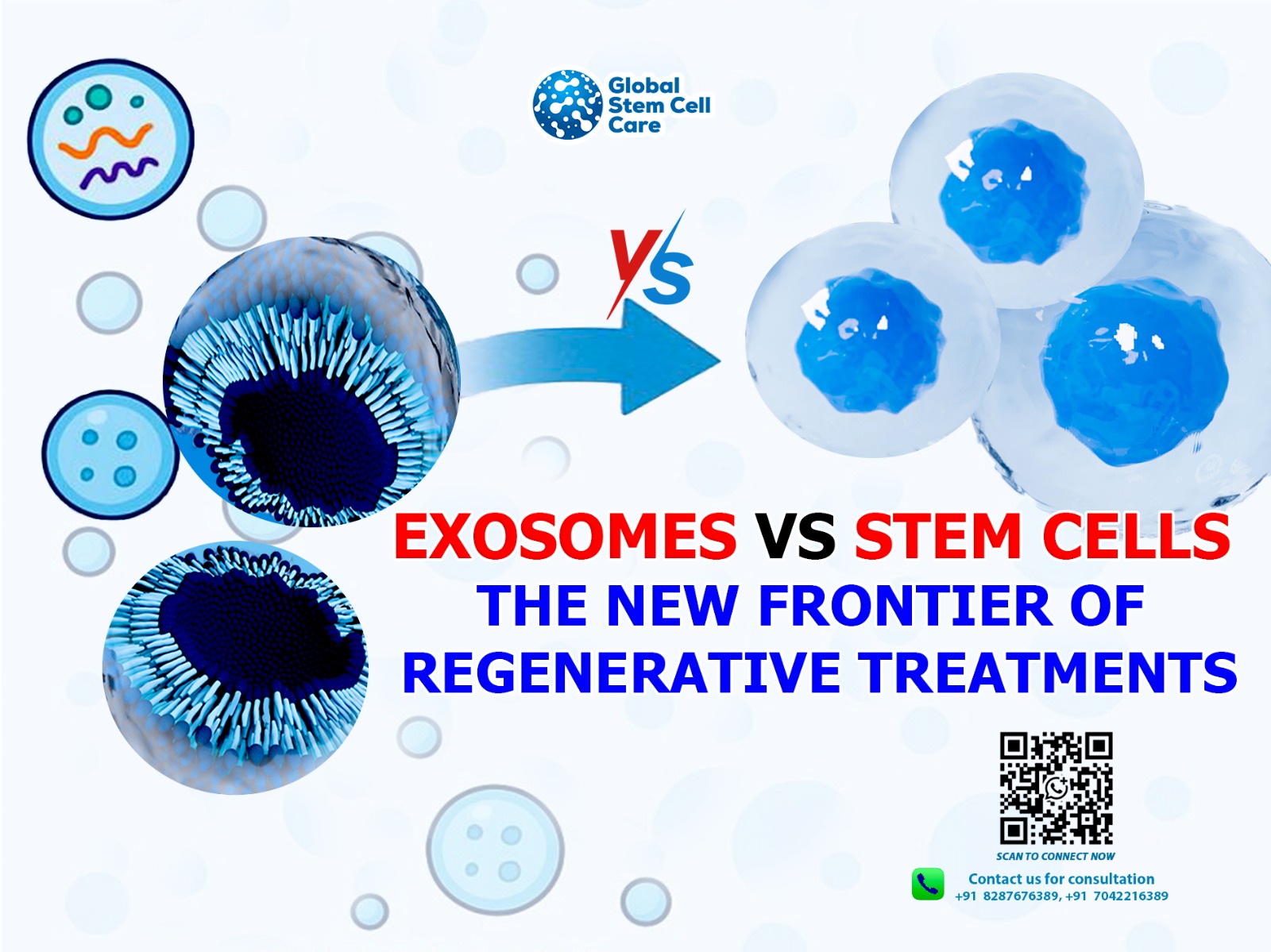
Exosomes vs Stem Cells: Core Biological Differences
| Aspect | Stem Cells | Exosomes |
| Biological Nature | Living, undifferentiated into cells capable of responding dynamically to the tissue’s environment | Cell-free extracellular vesicles carrying biological signals. |
| Primary Function | It supports regeneration through immune modulation, signaling, and interaction with damaged tissues. | Deliver precise molecular instructions to regulate healing and inflammation. |
| Mode of Action | Interacts with surrounding tissues and adapts to biological conditions | Acts as a controlled signal carrier without cellular interaction. |
| Predictability | Results may vary from patient to patient, depending on tissue condition, inflammation, and immune response. | More predictable due to standardized signalling profiles. |
| Safety Consideration | Require strict GMP processing and regulated clinical use. | Lower risk profiles, as they do not divide, migrate, or transform.
|
| Research Focus | It is used as a foundational regenerative tool in controlled protocols. | Increasingly studied as supportive or complementary regenerative agents. |
Why Combination Approaches Are Gaining Attentions
Current regenerative research favors coordination over isolation. Instead of asking “stem cells or exosomes,” scientists now explore how both can work together.
- The stem cells trigger regeneration processes.
- Exosomes amplify and direct those signals.
- Inflammation is kept under better control
- Tissue response is more predictable.
This echoes how healing in nature takes place, not through one single interference, but rather through layering biological communications.
For Expert Advice
Before pursuing regenerative therapies like stem cell therapy and exosomes, patients should contact an expert. A consultation conducted by experts at Global Stem Cell Care can help evaluate whether the individual is a suitable medical candidate for the regenerative treatment, understand the scientific facts, and gain clarity on the standards for safety.
The Concluding Thoughts
By 2026, regenerative medicine is expected to be in a mature phase. Exosomes will not replace stem cells, and stem cells will not become outdated. The hope for the future lies in understanding more about communication, safety, and coordination within biology itself. With guidance and scientific planning, regenerative medical therapies can be investigated responsibly and appropriately.
Frequently Asked Questions
Q1. Are exosomes better than stem cells?
Ans. None is absolutely better. They have different biological functions based on the condition and patient profile.
Q2. Can exosomes replace stem cell therapy?
Ans. Exosomes are an addition to stem cells, but they don’t cover the whole range of their biological functions.
Q3. Are these treatments approved everywhere?
Ans. Many applications of stem cells and exosomes are still under clinical research and regulatory review, with approvals varying by country.
Q4. Why do patient outcomes vary?
Ans. Variables include patient biology, disease severity, inflammation levels, immune response, and overall tissue health.
Q5. Why is consultation necessary before treatment?
Ans. This process also ensures the association of the science with a patient and thus helps prevent unsafe and unrealistic options.
Reference Links
Squillaro T., Peluso G., Galderisi U. – Clinical Trials with Mesenchymal Stem Cells: An Update
https://pmc.ncbi.nlm.nih.gov/articles/PMC3636724/
Trounson A., McDonald C. – Stem Cell Therapies in Clinical Trials: Progress and Challenges
https://www.nature.com/articles/nrm.2015.10
Galipeau J., Sensébé L. – Mesenchymal Stromal Cells: Clinical Challenges and Therapeutic Opportunities
https://www.sciencedirect.com/science/article/pii/S1525001625000930
Yáñez-Mó M. et al. – Biological Properties of Extracellular Vesicles